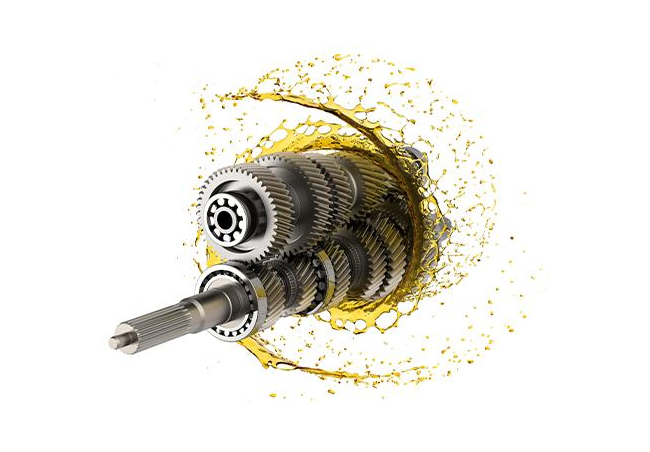
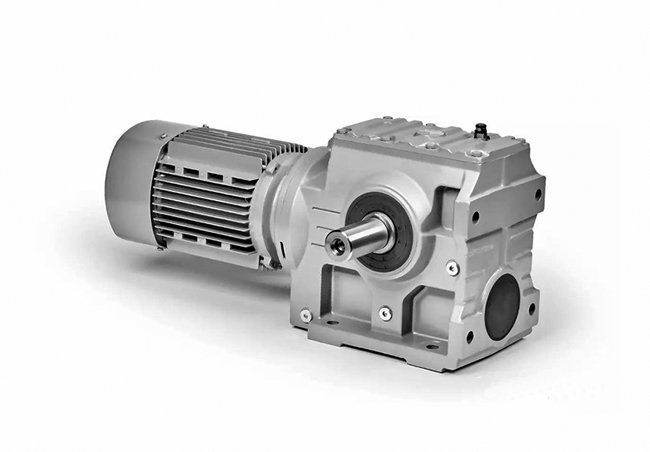
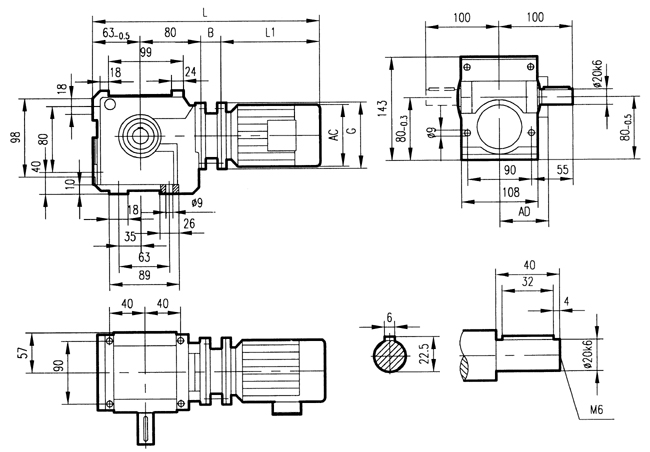
The main disadvantage of spur gears in spur gear reducers is that they generate vibration. Due to design, manufacturing, or deformation reasons, some changes in the involute profile may occur along the entire tooth surface at the same time. This will result in a regular, once per tooth impact, which is often very strong. The resulting vibration causes both large loads on the gears and noise. Another disadvantage is that sometimes the additional strength obtained from the meshing of two pairs of teeth during the contact time cannot be utilized, as the stress is limited by the condition of single tooth meshing in the cycle.
The helical gear used in the helical gear reducer can be regarded as a cylindrical gear made up of a set of thin helical gears arranged in a staggered manner. In this way, the contact between each piece is at different parts of the tooth profile, which compensates for the error of each thin helical gear. This compensation effect is very effective due to the elasticity of the teeth. Therefore, it can be concluded that teeth with an error of less than 10mm can evenly distribute the error, and can run smoothly under load like teeth with an error of less than 1mm. Because at any given moment, approximately half of the time (assuming a coincidence of about 1.5), there will be two teeth meshing, which brings additional benefits in terms of strength. Therefore, the stress can be established on the basis of 1.5 times the tooth width, rather than one tooth width.
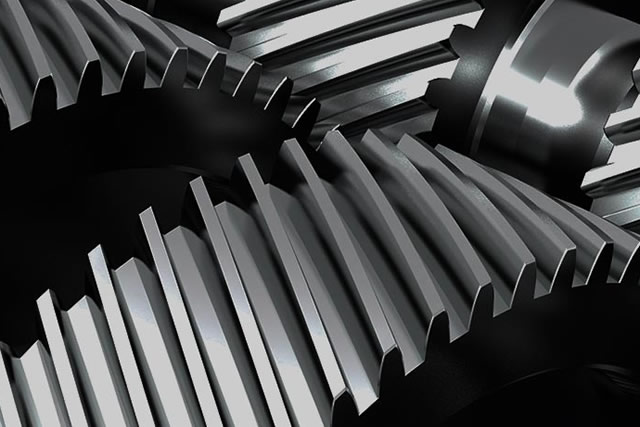
It is difficult and uneconomical to manufacture and assemble a large number of thin helical gears, so they are manufactured as a connected gear with teeth along the spiral direction. Unlike spur gears, helical gears can cause poor axial forces. But the benefits in terms of vibration and strength far outweigh the drawbacks caused by axial thrust and slightly increased manufacturing costs. Therefore, helical gears are selected instead of spur gears in the manufacturing of reducers For example, the four major series produced by Taili reducer include R series coaxial helical gear reducer, K series spiral bevel gear reducer, S series helical gear worm gear reducer, and F series parallel axis helical gear reducer. There are also DJYG series high torque extruder reducers, ZLYJ series single screw extruder reducers, and SZ conical twin-screw extruder reducers all using helical gears.